I once asked my dad to tell me what he remembered about his grandmother. He squinted his eyes, trying to resurrect a memory of her that would satisfy his inquisitive daughter. My father was only six when his grandmother died in Denver, Colorado, so I wouldn’t have blamed him if he had no mental image of her. I suspect he only saw her a time or two, if that. However, after a time, my father looked at me and said, “I recall her having black hair sprinkled with grey. Wore it short. I’d say she was about 5’2” and stout. And it seems like she was a good cook.” I’ve since wondered if he actually remembered these things about her, or he picked them up from a conversation he once heard. Regardless of the source, I’ve held onto these tidbits to help humanize a woman I know little about.
My great-grandmother, Emma Merkt, was born in Coffeyville, Kansas, on November 27, 1873, one of seven children born to German immigrant parents, John Georg (John) and Christina (Baier) Merkt, who had come to America when they were teenagers. Emma spent her first 13 years on a Kansas farm, like Dorothy in “The Wizard of Oz.” Her father’s obituary states that he was a missionary for the Lutheran Church, so religion must have played an important role in their family life.
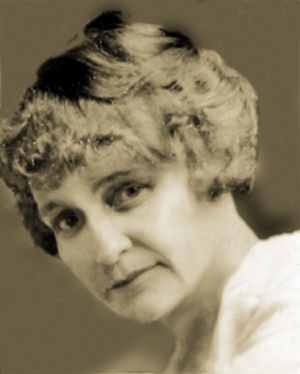
Emma Merkt (1873-1937)
Before medical research discovered the cause and cure of diseases like malaria and typhoid fever, these illnesses frequently swept through Midwestern communities at certain times of the year, taking the lives of young and old and devastating families. Such was the case when, in the fall of 1886, Emma’s mother succumbed to typhoid fever at age 44. It’s not difficult to imagine the loss a thirteen-year-old girl would have endured losing her mother at that critical time in her life. Emma had at least five siblings, two sisters who were 15 and seven when their mother died, and three brothers, aged 21, 19, and 15 at the time. Emma’s father may have felt the need to start afresh after his wife’s death and business opportunities elsewhere may have promised a better future for his family than farming. Whatever the reason, John abandoned the farm and departed for Colorado, where gold and silver mining and the booming railroad industry were attracting settlers from all over the country. Emma and two of her siblings accompanied their father in a covered wagon to Chaffee County in southern Colorado. It’s possible they may have lived in the wagon for a time until they could find a suitable place to live. John eventually became a patent medicine salesman, a popular and sometimes lucrative trade in that day, though considered more of a shady occupation as the medical profession and pharmaceutical industry developed.
Emma must have had some schooling in Colorado, for census records indicate that she could read and write. Like many girls of that era, Emma learned to sew, developing a talent for needlework she used to support herself later in life.
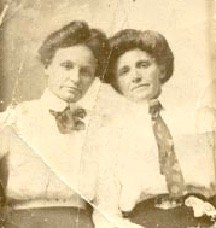
The woman on the left is believed to be Emma Merkt.
When she was in her mid-teens, Emma met a young man who had migrated from an Iowa farm with his older brother, joining thousands of men hightailing it to Colorado and California in those days to make a killing in gold and silver mining. William Parrett (Bill) and his older brother, Hillis, arrived in Colorado around 1889-1900. At some point, the brothers parted ways. Bill apparently decided that mining wasn’t for him, while Hillis eventually moved to the Sierra Nevadas, where he and his uncle Jasper, worked a successful mine, eventually called The Parrett Mine, in Mono County near Lundy Lake.
Bill met Emma Merkt shortly after his arrival in Salida. Though she was only 17 at the time, 25-year-old Bill asked her to marry him. Emma’s young age required permission from her father, which he gave, and the couple was married on February 12, 1891, in Salida. Ten months later, their first child was born, a daughter they named Olive May. Three more children, another daughter, Ethel, and then two sons, Edward (Ned), and Glen (my grandfather), arrived at regular intervals. My heart goes out to young Emma, married and pregnant at 17, the mother of four by the time she was 26. Would she have married so young had her mother been alive?
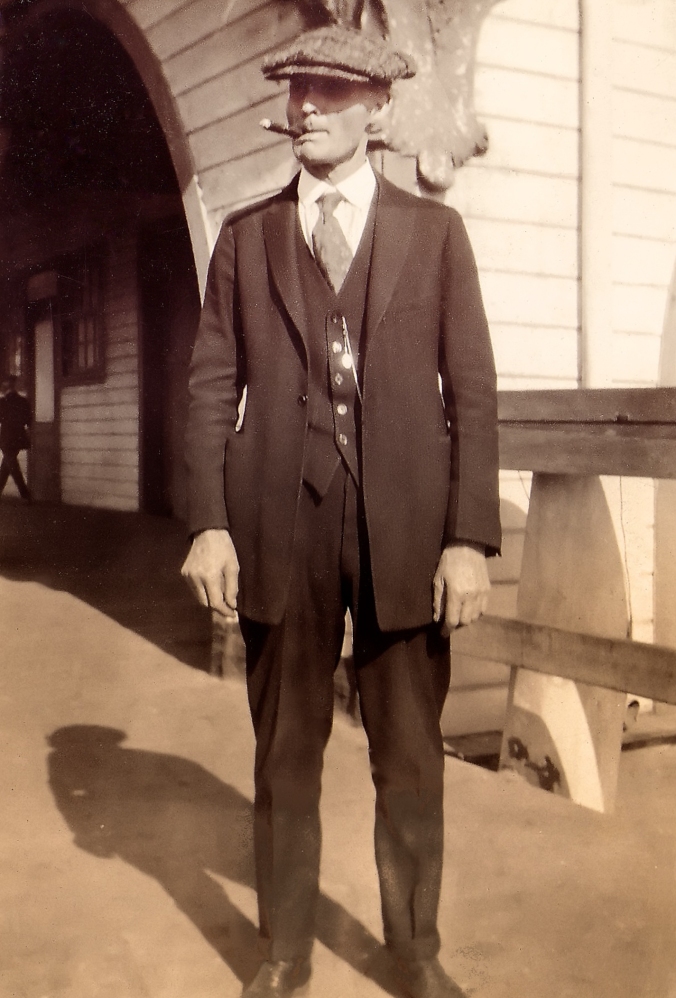
William E. Parrett working as a railroad detective.
The young couple remained in south-central Colorado for a time, and life clearly must have been difficult. Their oldest child was born in Hooper, which today is in the middle of nowhere, with a population of 126 residents. Then it was a busy railroad and trading town. One record reports that Bill worked as a driver in Hooper. Eight years into their marriage, they headed north, staying for an unknown amount of time with Bill’s father, Joseph Parrett, who owned a large farm in Jefferson County, Iowa. Joseph’s wife had died five years earlier, and he probably appreciated having a young family residing with him and helping out on the farm. It was there in 1899, that Emma and Bill’s last child, Glen was born.
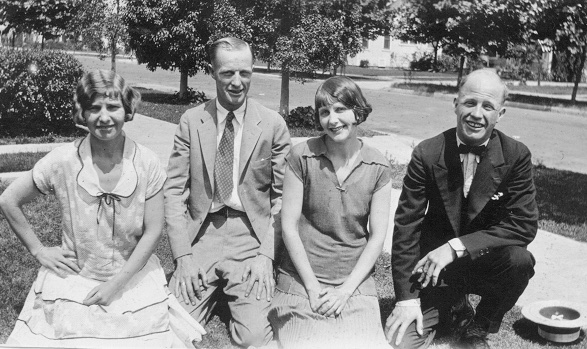
Emma’s children: Ethel, Ned, Olive, and Glen
The 1910 Census reveals that by the time baby Glen had grown to the age of 11, Bill and Emma were farming on their own on a rented farm in Kearny County, Nebraska. That same year, Emma’s father, John Merkt, died of a heart-related illness in Salida, Colorado.
At some point, Emma and Bill returned to southern Colorado and settled in the Pueblo area. By 1910, their two daughters had married, and their eldest son, Ned, married in June. Apparently, Bill and Emma’s marriage had run into difficulties at some point, and they had filed for divorce. Their divorce was final on June 23, 1917, nine days after Ned’s marriage.
Little is know about either Emma or Bill after their divorce. Bill and his son Glen lived together for a time in Pueblo, where Glen worked as a delivery boy for a grocery store. Glen met Ethel Nelson in Pueblo and followed her and her family to Los Angeles when the Nelsons moved there in 1920. At some point, Bill began working as a railroad detective for the Denver and Rio Grande Railroad, eventually settling in Denver, where, according to the 1920 census, he was living on Larimer Street and living alone. A life-long cigar smoker, Bill died of carcinoma of the lip on January 11, 1930, at the age of 63. He had moved to Los Angeles nine months before he died and stayed with his daughter Olive.
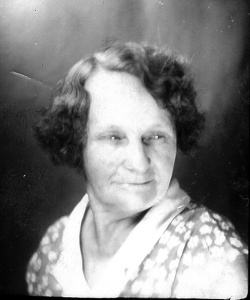
It’s unclear where Emma lived immediately after her divorce. I couldn’t locate her in the 1930 census, but I found her in the 1933 Denver City Directory, living alone at 1627 Laurence Street in Denver and working as a seamstress. She was still living at the same address at the time of her death on July 14, 1937. Sadly, none of her children were living nearby during her final years. Olive, Ethel, and Glen were in Southern California and Ned was in Arizona.
I visited Fairmount Cemetery, where Emma was buried, when I went to Colorado on a family history research trip in 2000. It made me sad to discover she had an unmarked grave and realize that not one of her children had purchased a grave marker for her, they had for their father. I let a number of years pass before getting around to doing anything about it and, finally in 2015, I ordered a gravestone for her. She is listed on her death record as Emma Merkt, which is the name I had engraved on her marker. May she rest in peace.
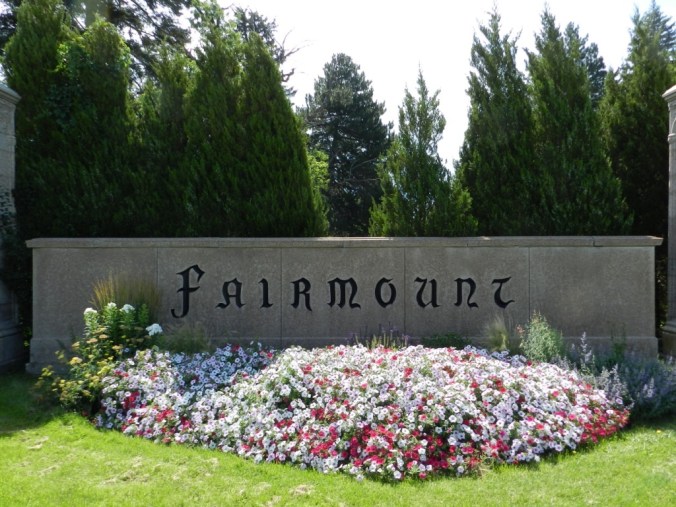
Fairmount Cemetery, where Emma Merkt is buried.
 Writing My Roots