Our female ancestors are frequently neglected by family historians. As I’ve researched my Ornduff ancestry, I’ve been impressed with the women of that family, who, like many pioneer women, led remarkably difficult lives, their stories sadly lost to time because they were not recorded. In this brief profile, I’ve tried to capture what I’ve learned–and what I imagine–about the heroic life of Mary A. Ornduff, my gg-grandmother.
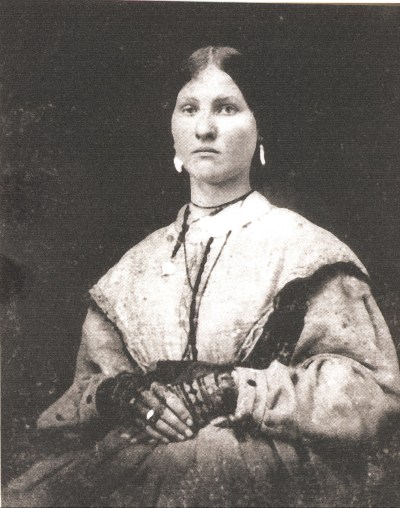
Mary A. Ornduff Parrett around the time of her marriage
Mary and her twin sister, Martha, were born on August 11, 1846, in Coles County, Illinois. Mary was a redhead! Her mother was also a Mary—Mary Jane, a Willoughby before she married John Ornduff when she was twenty. I’ve never discovered what Mary’s middle initial, A, stood for. Mary Anne? Mary Alice? Evidently her parents chose a different middle name for their daughter to avoid confusion with the mother.
Mary’s parents were both from Virginia, descended from forebears who had migrated to America prior to the Revolutionary War, some eventually serving in the war. The Ornduffs came from Germany originally and the Willoughbys from either Scotland or Ireland. Mary’s father had been previously married to Melinda Davis, from Washington County, Virginia. Melinda died in 1829, shortly after the birth of a son, and John married Mary Jane three years later. She was also from Washington County and may have been related to the Davises. Shortly after their marriage, the couple moved to what is now the Charleston area of Coles County, Illinois, where John established a farm. When Mary and her twin sister, Martha, were born, their mother and father were 34 and 44, respectively, and had been married for 12 years. Five siblings preceded the twins in birth: the eldest, a girl, Elizabeth, then four boys, Andrew, James, Samuel, and Franklin.
Mary was born the year Iowa became a state. “Iowa fever” had been in the air for some time, for Illinois families had heard reports about the cheap fertile farmland available west of the Mississippi River. When Mary was a year old, the Ornduffs joined thousands of families who packed their belongings in ox-drawn wagons and headed west. The trails west teamed with settlers in the fall of 1847 when the Ornduffs made their move. For some months, the Mormons had been making an exodus from Nauvoo, Illinois, passing through Iowa on their way to the Salt Lake Valley.
There were at least ten who came with the Ornduff wagon. The 1850 Iowa census records the family consisting of the parents and their seven children and 21-year-old William Ornduff, probably John’s son from his first marriage. It’s possible William accompanied the young family to help out on the journey, for he returned to Virginia a short time after the Ornduffs reached Iowa. The family settled in Locust Grove Township in Jefferson County, located in the southeast corner of the state, one of the first areas in Iowa to be settled because of its proximity to the Mississippi River.
In October 1847, Mary’s father bought 40 acres of land in section 17 of the township and another 40 acres in section 18. Four months later, he bought an additional 40 acres. Eventually the family would own 231 acres in the township. Land in Locust Grove had been for sale since 1838, nine years earlier. It’s possible that the land John purchased had been previously bought by speculators.
Other settlers preceded Mary and her family to Locust Grove. The main town, Creaseville (later Batavia), was laid out a year earlier. By the time the Ornduffs arrived, Jefferson County already had a courthouse, jail, sawmill, and more than 8000 inhabitants.
When Mary was two, another baby, a brother named Volney, joined the family. Eventually, there were 13 Ornduff children, seven girls and six boys. Mary’s mother bore children over a 27-year period, and was 48 when the last child, Joseph, was born.
Mary undoubtedly spent her early years helping her mother with household chores and tending her siblings in their busy household. Later census records state that she was illiterate, indicating that there was probably little time or opportunity for her to attend school. Mary’s mother joined the Cumberland Presbyterian Church when Mary was two, so the family undoubtedly attended church together. During Mary’s childhood, there was a severe hurricane in 1848 that damaged much of the county and a cholera epidemic in 1850 that took the lives of many who in the southeast section of the state. When Mary was eight, the state fair was held in nearby Fairfield. The fair, which lasted three days and cost 25 cents admission, must have been a happy, festive occasion for Iowans.
In 1861, when Mary was 14, the Civil War began, and many Jefferson County men joined the ranks of Company F of Iowa’s Third Cavalry. At least three of Mary’s brothers were among them. Both Franklin and Samuel enlisted on August 30, 1861, when they were 19 and 20, respectively. Volney joined three years later, six months shy of his seventeenth birthday. Brothers James and Andrew may have served as well but no records have been found to verify their service. It must have been a great worry and a substantial sacrifice for the family to have at least three, and maybe five, of the Ornduff children serving in the war at the same time. If all five sons served in the war, the heavy labor of the farm would have been left primarily to John, for except for four-year-old Joseph, only women remained in the household.
Before her brothers returned from the war, Mary married Joseph Parrett, whose family lived on a neighboring farm. Mary was only 17 when she married 21-year-old Joseph on December 11, 1863, at the Ornduff home.
Joseph was the oldest of five sons born to David Mann Parrett and Barbra Webb Parrett. The Parrett family had migrated to Iowa by oxcart in 1850 from Fayette County, Ohio. Joseph came from a long line of farming families whose roots had begun in America in the 1730s, when German-speaking Frederick Parrott migrated from the war-torn Rhineland.
Land records show that David Parrett first purchased land in section 16 in 1856. Because the Parretts and Ornduffs resided on adjoining properties, Mary and Joseph undoubtedly knew each other throughout their youth. Joseph served in Company F of the Third Cavalry alongside Mary’s brothers, but after serving only a year, he was discharged with chronic intestinal problems that would plague him for the rest of his life. Joseph’s military records indicate that he was five-foot-nine inches, with hazel eyes, brown hair, and a dark complexion.
The tintype of Mary above captures her at about seventeen, the age she was when she married. She looks serious and stately, seated in a formal pose with her hands folded in her lap. Mary has parted her hair in the middle and clasped it at the nape of her neck, showing off her pale, flawless, redhead’s skin. She has full cheeks, a long neck, one of her most distinguishing features. She wears a fancy dress, its V-shaped bodice trimmed in dark lace that creates a dropped-shoulder effect. It’s likely the nicest dress she’s ever worn, and it was probably homemade, taking days, even weeks to fashion from what looks like homespun fabric of a coarse texture. She looks every bit the product of her time and place, destined like most girls of that era to relive the hard life her mother had modeled for her.
Ten months after their marriage, Mary gave birth to their first child, a son they called Hillis, who inherited his mother’s red hair. Ten more children followed over a twenty-one-year period, for a total of seven sons and four daughters, including a set of twins. One of the sons would die in infancy.
Land records indicate that Joseph purchased 40 acres of land in 1872 when he was 30, nine years after his marriage, and another 40 acres a decade later. When he was 48, he purchased 40 more acres from his father.
While seemingly immune from some hardships, the family was continually challenged by Joe’s precarious health. Some dozen affidavits in Joe’s pension file tell a story that begins in 1863 and continues through the decades until Joe’s death, sixty years later. It’s a tale of chronic disability spun through the testimony of Joe’s military commander, relatives, neighbors, and doctors. Each narrator tells a story similar to the one that follows:
During 1863 and 1864 he was able to be about part of the time and perform some light labor such as driving a team but not able to farm any from 1864 up to 1872 he has been about part the time and layed up part the time every summer and fall he would have a bad spell allways worse in August and September than at other times he would get able to do light work but to our knowledge during the said period he has never been able any one year to make what would be called near a half [indecipherable] on a farm and as he get older his spells of Chronic Diarrhea gets worse and he gets weaker.
The various pension affidavits make it clear that relatives, friends, and neighbors assisted the family with farm labor through the years. Fortunately, Joe and Mary’s first four children were boys: Hillis, William (my great-grandfather, called Bill), John, and Ele Azor (sometimes called Ele), who were born at two-year intervals. I suspect they worked long, hard hours as soon as they were able. I find it difficult to imagine the burden Mary shouldered and the hardships of each day of her life. Mary was only twenty-six when she gave birth to her fifth child, her first daughter, whom she called Anna Jane. Three more daughters followed, twins Iona and Regena May (called May), and Ada. Her ninth child, an unnamed son, lived only two weeks. Her last two children were sons, Russell and Guy. Mary was forty-two when Guy was born.
For Mary and other women of her era, childbirth remained a feared part of life, with mortality rates for mothers and babies still high. The Locust Grove community had a doctor during the years Mary was having her children, but doctors traveled by horse if they were free from other obligations and if the weather permitted. Women in labor in that era often relied on the assistance of neighbors and relatives who could become skilled midwives over time. Mary would not have lacked for support, with her mother, mother-in-law, twin sister, and other sisters and cousins living nearby.

This photo of Joseph Parrett was taken in Ottumwa, Iowa, on the occasion of the 50-year reunion celebrating Iowans who had served in the Civil War.
Unfortunately, when Mary was 34, she lost her mother, who died at the age of 70 of a lung disease, possibly pneumonia. She was buried in Abingdon Cemetery. Four years later, Mary’s father died at age 83 and was buried alongside his wife. Between the deaths of her parents, Mary gave birth to her eighth and ninth children.
The remaining years of Mary’s life were undoubtedly busy with raising children and tending to the laborious duties associated with farming. Besides typical female responsibilities, frontier women frequently walked behind the plow, holding the plowshare steady with its thick handles, planted corn and wheat, and helped with other kinds of heavy work on the farm. Though unable to perform much physical labor, Joseph served twice as a Batavia town trustee and was active in the Kilwinning Lodge of the Masons for 53 years.
The string of family losses and the pressure of managing a large farm and family while sustaining a disabled husband undoubtedly took a toll on Mary’s health. In an era when access to doctors was limited, antibiotics unheard of, people still mostly doctored themselves, depending on “old wives’ remedies” and patent medicines, primarily morphine and liquor concoctions, to cure most ailments. A sudden, devastating illness could steal away a life in record time. Almost without warning, Mary’s life ended at age forty-seven, when, like her mother, she contracted pneumonia and died on February 12, 1894, after a few days’ illness. She left an ailing husband and at least five children at home, the youngest only five. One may speculate that Mary was taken by an epidemic, for her 16-year-old daughter Regena May died three weeks later. Both were buried in Batavia Cemetery.
Joseph lived another 30 years, never remarrying. He spent the last 13 years of his life at the home of his daughter Anna in Ottuma, Iowa. Joseph died on April 4, 1924, at the age of 81, and he was buried alongside Mary in Batavia Cemetery.
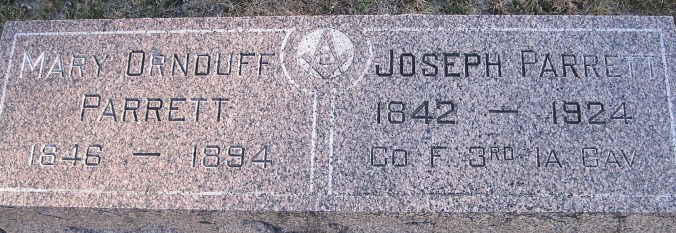
Mary and Joseph were buried in Batavia Cemetery in Batavia, Iowa.
Joseph’s probate record indicates that he left an estate of around $10,000, which was administered by his son John. After court costs and burial expenses were deducted, each of the nine living children received a bequest of around $1,000, with Anna receiving an additional $1,015 “for care and keep of Joseph Parrett.”
By then, many of Mary and Joseph’s children had moved away from Iowa, Hillis and William settling in California, Eleazor and Russell in Missouri, Ona in Washington, Guy in Oregon, and Ada in Virginia. Only John and Anna remained in Iowa.
 Writing My Roots
I have some Parrett stories from Locust Grove Iowa that I would like to share with you. My family just found your book “The Parrett Migration” and would love to get in touch with you.
LikeLiked by 1 person
Yes, I’d love to hear from you. Please email me at thurstondawn@gmail.com.
LikeLike
Looking for any descendants of Daniel Willoughby (1833-1910), born in PA but moved to Clarion, Iowa, possibly in 1850s. Thanks. Wayne Warner
LikeLiked by 1 person
I suspect your Daniel is somehow tied in with my Willoughbys, but I’m not sure how. The family was in Pennsylvania for a while. I followed my ancestor into Jefferson County, Iowa, in 1847, but I haven’t done any research on related lines.
LikeLike
My great grandmother, Agnes Stewart, with her family, left the Butler PA area in the spring of 1853 for Oregon, via Ohio, Mississippi, and Missouri Rivers and then by covered wagons from St. Joseph, MO. She corresponded with J.D. Willoughby who had read in a Pittsburgh that the wagon train had been attacked by Native Americans. Willoughby wrote on Jan. 8, 1854. He also said that his son Daniel wanted to pass on a word: “Daniel wishes me to say that he is sorry that he let you go or that he didn’t go with you.” They were both 20. Maybe someone could write a song of lost love. Agnes married a Tom Warner and settled in Lane County, Oregon. A middle school is named for her in Springfield, OR. I traced Daniel to Clarion, IA where he died in 1910.
LikeLike
It appears you’re pulling together a very interesting story. You’re fortunate to have found some personal details. Research like this is addicting…and fun.
LikeLike
I know Agnes wrote to J.D. Willoughby because he is answering her letter of Nov. 20, 1853 that corrected the bogus Indian attack report. I know this part is not concern of Willoughby family, but if anyone is interested in the wagon train the Stewarts were on can look for writings on “The Lost Wagon Train of 1853.” They were not really lost, but someone told about a thousand people that they could take a shortcut over a new road in Oregon. So, they split off the Oregon Trail close to what is now the Oregon-Idaho border. But there was no road, and they had to hack their way through trees, abandoning their wagons, and didn’t arrive in the Willamette Valley until October, 1853.
LikeLike